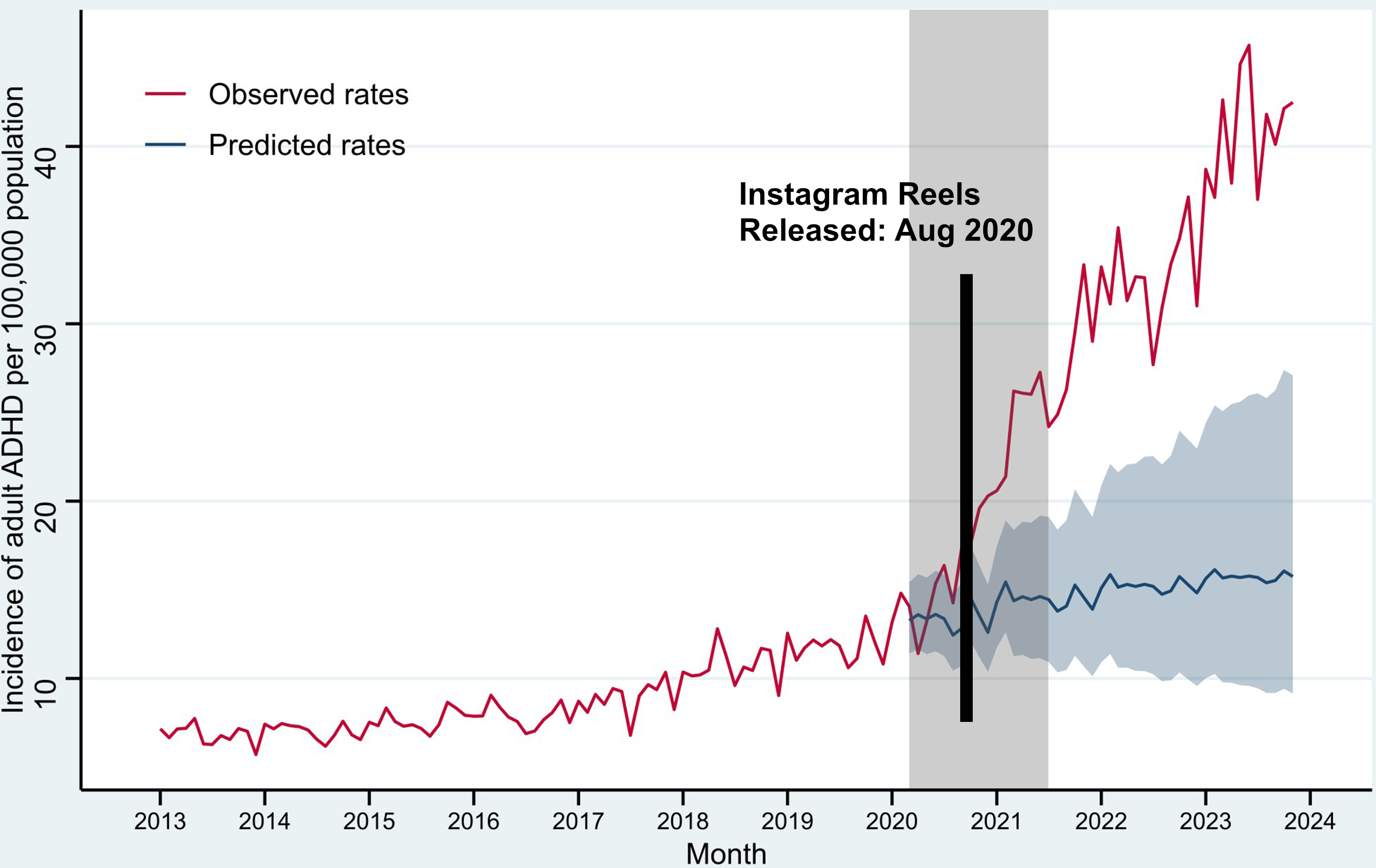
The graph referenced in this article was published in The Lancet by Kevin Hu, et al. in 2025. The study was based on public mental health data in B.C Canada. It should be noted that the mark on the Instagram Reels release date was added post-publish by VINDICA for the sake of this article.
For legal reasons VINDICA is not suggesting any cause for mentioned trends, merely presenting ideas.
Key notes to know before reading:
- Since 2018: ADHD Diagnosis has increased by approx. 4x (In BC) (Hu, et al., 2025)
- Since 2019: Rates of Depression in the US have increased by approx. 46% to greater than 18% of adults now diagnosed or treated (Gallup Panel, 2025).
- Instagram Reels was released in August 2020
- TikTok was released in 2018 and over the period 2019–2022, its popularity grew 3.8x to approx. 1.4 billion monthly users.
Homeostasis is the body's way of maintaining a stable internal state. It works to adapt to new environments and changes to maintain a baseline throughout the body. Homeostasis can be thought of as a governing principle across all of our body's systems.
Change → Adaption → Return to Baseline.
Excitement and entertainment falls under the rule of homeostasis. We all know that watching a movie for the first time is never as entertaining, suspenseful or exciting as the second or third time round. This is intuitive and common knowledge.
With the idea of homeostasis as context, ask yourself: what does watching 2 hours a day of Instagram Reels and TikTok do to me?
Adaption.
Adaption to the ultra-stimulating, fast-paced content that has been engineered within the 'Reel'. 15-second multi-layered clips expose the brain and body to the highest information-density content in history. Exposure to this for hours each day begins to set a new baseline. When faced with such a large stimulus the body adapts quickly to maintain the baseline — only this time the baseline is set at the level of the reels. The baseline becomes ultra-stimulating, fast-paced information.
Imagine now what this baseline makes the real world look like.
Boring.
Relative to the excitement and stimulation of TikTok and Instagram, the real world appears dull. Naturally, people then tend to avoid this dullness, favouring staying online to maintain their baseline. Constant exposure to stimulating exciting content makes the real world feel less real, less exciting, less lively.
What, then, does this look like when 2 billion people are exposed to this for more than 1 hour a day?
Agitation. Depression.
To live in a world that is relatively boring naturally produces mental health issues. Exposed people lose the ability to focus as tasks appear more and more boring (relative to baseline). Life events are less entertaining and exciting (relative to baseline). Real sounds and sights lose their potency (relative to baseline). ADHD and depression-like symptoms are naturally going to follow this.
The trends show a correlation.
It is up to you, the reader, to decide: is there causality?